Finding and Photographing Kingfishers
The Kingfisher is a bird that has always felt elusive to me. Before last week, I had seen two Kingfishers in my 49 years on this earth and those sightings were not brilliant. The first was last summer when I was walking my dog. We went to a local reed pond which is quite isolated. I go there with my dog because it is not visited that much, so it is a nice peaceful place to relax. In the summer it is very overgrown and you are guaranteed to get a number of ticks if you take a trip there, but it is quite beautiful so I do go there occasionally in the summer and then do my best to check for ticks afterwards. On this occasion we walked towards the edge of the pond and as we did, a bright patch of blue flew across to the otherside of the pond. We had stumbled upon a Kingfisher, and after seeing it briefly, it was gone again. The other time I saw one was on a trip to an RSPB nature reserve, and there was a great deal of commotion in one of the hides when a Kingfisher was spotted. There was a lot of pointing and describing and I then saw what was being described through my binoculars, but it was so far away that I just saw a tiny spec of blue in reality. So as you can tell, neither of these sightings were particularly satisfying.
Equally, I have never really been out to look for Kingfishers. I might have had more success if I went out with that purpose, but most of my wildlife sightings happen by chance, and I whilst I am likely to have a camera on me, it will just be with a 35mm or 50mm prime lens, so I am rarely in a position to capture a photo. When I saw the Kingfisher at the reed pond, I had my camera on me with a 35mm lens and did not even consider trying to get a photo.
On Christmas Eve, my wider family went out for an afternoon walk to get a bit of exercise in for us and our dogs before the festivities of Christmas began. We live in Surrey, and went to a local river and walked along it for a while, and after a short while we came to a pond and after a little bit of time looking at the ducks and swans, someone said ‘Kingfisher!’. Again, lots of excitement began followed by plenty of pointing and describing, but sure enough there was a Kingfisher on the other side of the pond. Fortunately for us, this beautiful bird was diving, and then retreating to the branches by the pond side, and it got a lot closer so we all got a chance to see it. A lovely experience, but I thought to myself that I would never be likely to get a photo of the bird because I am never likely to have my heavy, bulky Nikon telephoto lens with me for these opportunistic sightings. Over the next few days I tried to think about what equipment might be available to walk around with for situations like this, but I gave up on it and got on with Christmas.
A week later, no doubt energised by the Kingfisher sightings on Christmas Eve, the same walk was suggested for New Years Eve. We were all quite realistic to assume that lightning was not going to strike twice, and this was a lovely walk whether or not we saw a Kingfisher. Nevertheless, I spent a lot of time thinking what to take with me, and I decided to stick my Nikon Z8 and big lens in the camera bag and take it with me. The big lens I have is the Nikon Z 180mm-600mm and it is a beast. I can just fit it in my camera bag with the hood off and no camera body attached, albeit it fits in the bag in an unconventional way. For me this is the reason I do not use it much because it is so cumbersome to take around with me, particularly as most of the time I am also taking my massive dog. If I take the same camera and a 40mm lens, I can put this on a strap and use it one handed. With the big lens, if I want to use it, I have to get it out of the bag, attach the camera body, and then it is a two handed operation. Hence, it only comes out on photography specific trips. This time however, I knew I would be able to pass the dog to my wife if a Kingfisher was around.
So we went out at the same time, parked at the same place, and walked the same route, and when we got to the pond, there was a Kingfisher. Brilliant! But it was not that simple. It kept on appearing, fishing and retreating to the middle of a bushy area, so whilst we saw it, it was not exactly an excellent composition. The best chance of spotting it was on the other side of the pond which just happened to be right next to a busy one-way road with a narrow pavement. Once the rest of my extended family had spent some time looking for it, they got cold and went to a coffee shop, so I thought I’d get my camera out and see what I could do. It was freezing and light was fading fast as sunset approached, so I gave myself 10 minutes to see what might happen. It felt like much longer but there was nothing, until all of a sudden the lovely bird appeared on a lone branch in a different area. I couldn’t believe my luck. It had left the busy bushy area and sat on a branch just for me - or at least that is what it felt like. I turned my camera towards it, just got focus and started snapping away. The ISO was so high though, and hand holding that camera and lens is tough. The bird was on the branch for about 10 seconds and then it was gone.
When I got home, I looked through my photos and the majority of them were not sharp. I suspect the combination of high ISO and shaky hands were to blame, and also I was at the far end of the lens’s focal range which is not the sharpest. Even so, there were a small number of photos that I was happy with. Here is one of them.
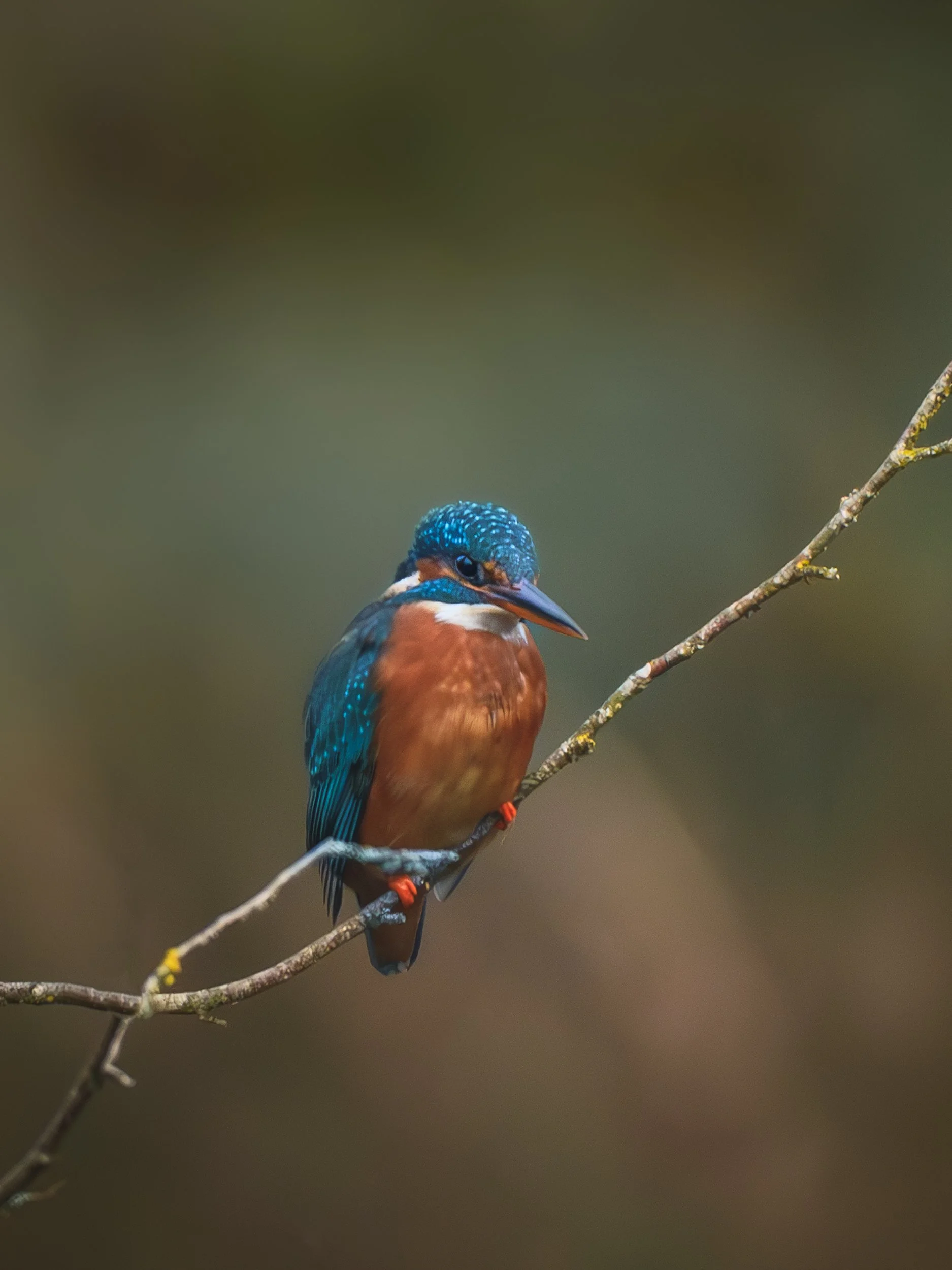
I am very pleased with this photo. The main reason I was able to get it was simply because I had the right camera and lens with me at the time. It does make me think that I should be a bit more mindful of where I am going and what camera equipment I take with me. Most of my favourite wildlife photos that I have got are opportunistic, and if that is the case, you need to be able to take advantage of those opportunities. If I had gone out with just my binoculars and seen the Kingfisher, I would have been thrilled, but to have been fortunate enough to get a photo that I’m very happy with, is the icing on the cake.